
Megawatt Calculator
A megawatt is a million watts — a measure of power, the rate at which energy is produced or used. Enter a power in MW (or kW or GW) to convert it, choose how long it runs to get the energy in megawatt-hours, and apply a capacity factor to estimate what a solar farm, wind farm or power station really generates in a year and roughly how many average homes that could supply.
- Free to use
- No sign-up
- Runs in your browser
Quick answer
To convert MW to MWh per year, multiply megawatts by 8,760 hours and by the capacity factor. At 100% output, 1 MW = 8,760 MWh/year, or 8.76 GWh/year. At a 24% capacity factor, 1 MW of solar is about 2,102 MWh/year; at 35% wind, about 3,066 MWh/year.
Megawatt calculator
Energy Units Reference Pack
Printable power and energy conversion sheets (W, kW, MW, GW, hp, BTU/h, kWh, MWh, GJ), a capacity factor worksheet and an energy project calculator workbook.
- Conversions (PDF/XLSX)
- Project calculator (XLSX)
- Capacity factor worksheet (PDF, DOCX)
Formats: PDF, XLSX, DOCX. Instant download after payment (link valid 72 hours, up to 5 downloads). AI-assisted: the templates were drafted with AI help and reviewed and laid out before publishing.
$5.00 USD, one-time 3 files · about $1.67 each
- Instant download
- 7-day refund
- Secure checkout by Stripe
7-day money-back guarantee. Full refund within 7 days of purchase, even after you download.
Full refund within 7 days — see the refund policy and license.
Free printables
Single sheets you can print right now, no sign-up. The full pack adds every sheet in one download plus the editable files.
MW to MWh per year examples
Use these examples to convert 1 MW of capacity into annual energy at common capacity factors.
| Capacity factor | Example type | MWh/year per MW | GWh/year per MW |
|---|---|---|---|
| 100% | Full output | 8,760 | 8.76 |
| 92% | Nuclear typical | 8,059 | 8.06 |
| 55% | Gas combined cycle typical | 4,818 | 4.82 |
| 45% | Coal typical | 3,942 | 3.94 |
| 37% | Hydro typical | 3,241 | 3.24 |
| 35% | Onshore wind typical | 3,066 | 3.07 |
| 24% | Utility solar PV typical | 2,102 | 2.10 |
Power versus energy
Watts measure power — how fast energy is used or produced at a moment. Watt-hours measure energy — power multiplied by time. A 1 MW generator running at full output for one hour produces 1 megawatt-hour (MWh). Electricity bills charge for energy (kWh), while power station and solar farm sizes are quoted in power (MW). Mixing the two up is the most common mistake in energy news: a “100 MW solar farm” does not produce 100 MWh every hour of the year.
Power unit conversions
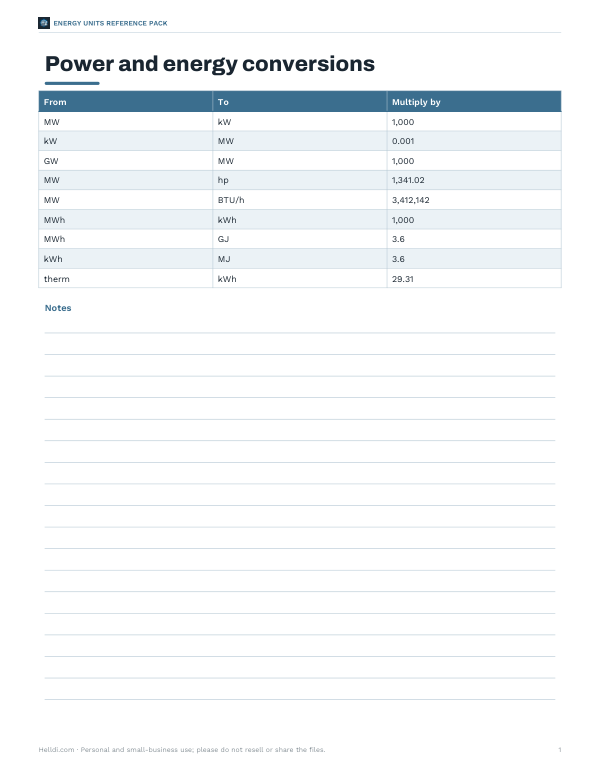
| Unit | Equivalent |
|---|---|
| 1 kilowatt (kW) | 1,000 watts |
| 1 megawatt (MW) | 1,000 kW = 1,000,000 W |
| 1 gigawatt (GW) | 1,000 MW |
| 1 MW | about 1,341 mechanical horsepower |
| 1 MW | about 3.412 million BTU per hour |
| 1 MWh | 1,000 kWh = 3.6 gigajoules |
Capacity factor
Few power plants run at full output all the time. The capacity factor is the energy a plant actually produces over a year divided by what it would produce running flat out for all 8,760 hours. Solar farms only generate in daylight and wind farms depend on the wind, so their capacity factors are much lower than nuclear plants, which run almost continuously. Typical US values are roughly: nuclear above 90%, natural gas combined cycle around 50–60%, coal 40–50%, hydro 35–40%, onshore wind 30–40% and utility solar 20–30%. Actual figures vary by site, year and design — enter your own if you know them.
How many homes does a megawatt power?
Headlines often say a project will “power X homes”. That figure is usually based on energy: annual output divided by the average home’s annual consumption. Average US household use is roughly 10,000–11,000 kWh a year (the calculator uses 10,500 kWh by default — change it for your region; many European homes use far less). A 1 MW solar farm at a 24% capacity factor produces about 2,100 MWh a year, enough on paper for about 200 average US homes. On an energy basis, 1 MW of nuclear capacity corresponds to roughly 770 homes.
How to use the calculator
- Enter the power and choose its unit.
- Choose a plant type to fill a typical capacity factor, or enter your own.
- Set the running time — for annual output, 1 year.
- Read the conversions, the energy produced and the approximate number of homes it could supply.
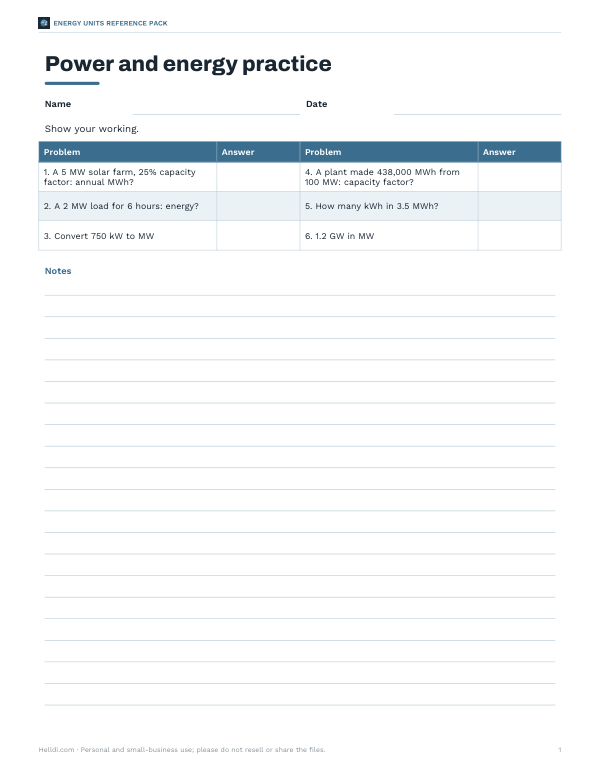
- Use “Running at full power” for simple power-to-energy conversions, such as a 2 MW load for 3 hours = 6 MWh.
Worked example
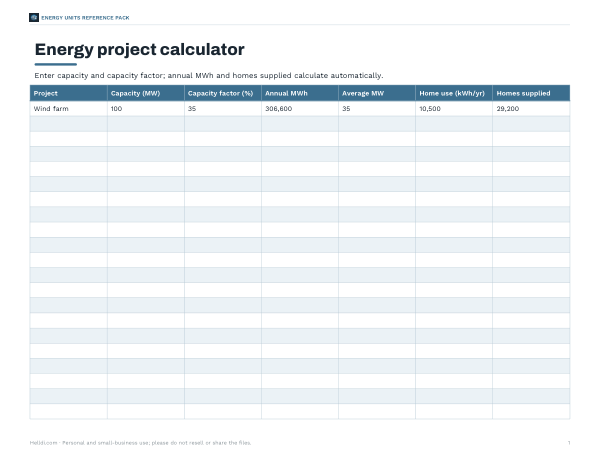
A 100 MW onshore wind farm with a 35% capacity factor produces 100 × 8,760 × 0.35 = 306,600 MWh (306.6 GWh) a year — an average output of 35 MW. At 10,500 kWh per home, that is enough energy for about 29,200 average homes over a year. The same 100 MW converted directly is 100,000 kW, 0.1 GW, about 134,100 horsepower or 341 million BTU per hour.
Megawatts in electricity markets
Grid operators balance supply and demand in megawatts minute by minute, while electricity is bought and sold in megawatt-hours. Wholesale prices are quoted per MWh — a price of $50/MWh equals 5 cents per kWh before network charges and taxes. Peak demand for a large city can reach several thousand megawatts on a hot or cold day, which is why grid planners care as much about capacity at peak times as about total annual energy.
Common conversion mistakes
- Treating MW and MWh as the same thing — one is a rate, the other an amount.
- Forgetting the capacity factor when estimating annual output from solar or wind capacity.
- Mixing AC and DC ratings for solar farms: panel (DC) capacity is usually higher than the grid connection (AC) rating.
- Using electrical horsepower (746 W) and metric horsepower (735.5 W) interchangeably — they differ by about 1.4%.
- Assuming “homes powered” means homes supplied at every moment; it is an annual average.
Scale of common power figures
| Example | Typical power |
|---|---|
| Electric kettle | 2–3 kW |
| Electric car fast charger | 50–350 kW |
| Large wind turbine (onshore) | 2–6 MW |
| Offshore wind turbine (new) | 8–15 MW |
| Utility solar farm | 10–500 MW |
| Large nuclear reactor | 1,000–1,600 MW |
| Data centre campus | 20–300 MW |
Ranges are indicative and vary widely by model and project.
Privacy
All calculations run in your browser; nothing is uploaded.
Frequently asked questions
How do I convert megawatts to MWh per year?
Use MWh per year = MW × 8,760 × capacity factor. If the plant runs at full output all year, the capacity factor is 1.
Is MW per year the same as MWh per year?
No. MW is power, while MWh is energy. For annual production, convert MW to MWh by multiplying by hours in the year and the capacity factor.
What is 100 MW in MWh per year?
At full output, 100 MW produces 876,000 MWh per year. At a 35% capacity factor, it produces 306,600 MWh per year.
How many kW are in a MW?
1,000 kW.
What is the difference between MW and MWh?
MW is power (a rate); MWh is energy (power × time).
How much energy does 1 MW produce in a year?
8,760 MWh at full output; multiply by the capacity factor for a real plant.
How many homes can 1 MW power?
It depends on the capacity factor and local use — roughly 200 US homes for solar, over 700 for nuclear, on an annual energy basis.
How many horsepower is 1 MW?
About 1,341 mechanical horsepower.
What is a capacity factor?
Actual annual energy divided by the maximum possible if the plant ran at full power all year.
How many MWh is 1 GWh?
1,000 MWh.
Is 1 MW a lot of power?
It is roughly the peak demand of several hundred homes, or one small wind turbine at full output.
What is the difference between MW and MWe?
MWe is electrical output; MWt (thermal) is the heat produced, which is higher for thermal power plants.
Is anything uploaded?
No, it runs in your browser.